Hello again!
We have been gearing up for the Michigan Brewers Guild's 2015 Winter Beer Festival. It is truly one of the unique beer events out there. This outdoor festival has been expanded to two days this year, and it promises to be a true celebration of Michigan weather and Michigan beer.
(Now let's take a moment of silence in appreciation for all of the volunteers that will be busting their tails in the freezing cold to help pull this event off!)
I like to view the Guild festivals as a time to really try and put on the best show we can for festival goers. Usually that entails brewing up some specialty small batches that will only be available at the festival. It is a time to get creative and spread our wings. In the past we have done a version of our Honey Kölsch that we infused with green tea. That beer was the brain child of the well bearded Aaron Stryker, now of Rhinegeist Brewery in Cincinnati. We have made aggressive Imperial IPA's, blended barrel aged beers with cherries, coffee beers, and others.
However, with our production schedule as full as it is, this year we did not have time to brew a lot of small batches, but that doesn't mean we aren't still excited about what we will be pouring. We will be pouring a host of bourbon barrel aged beers (Wheat Wine, Robust Porter, Belgian Amber), some new lagers that we have been working on, a Munich Helles and a Classic American Pilsner. Our Propaganda Red IPA will be pouring as well as a couple of cask beers.
As of right now there are still tickets available to the Friday session of the festival, while the Saturday session is sold out. If you do have tickets, makes sure to stop by and see us at the Cranker's booth!
Drink good beer with good people!
Showing posts with label craft beer. Show all posts
Showing posts with label craft beer. Show all posts
Saturday, February 7, 2015

Saturday, April 20, 2013
Dry Yeast Rehydration and "Closed Procedure"
Below is an article that I wrote with professional side brewing in mind. It can have broader applications for both amateur and pro brewers, so I hope you enjoy.
Craft beer is booming. The past decade has seen a meteoric rise in the number of new breweries dotting the landscape. Along with that, many homebrewers have stepped in to fill the growing demand for makers of artisan beer. The goal of this document is to help ease this transition to larger scale brewing by tackling an important topic, and discussing a key concept to the brewing process: yeast handling. The hardest working employee in any brewery is the yeast. A brewer can craft the finest wort possible, but if they do not create an ideal environment for the yeast to generate the desired flavors in the beer, an opportunity is lost.
Brewers pay a tremendous amount of attention to fermentation temperatures, yeast strain selection, and re-pitching approaches. An often overlooked aspect is yeast viability and the roll that rehydration plays in providing your yeast an opportunity to generate the flavors and attenuation levels you want. This document is aimed at the importance of rehydrating dry yeast, but also the "closed" process that it utilizes. It is applicable to handling liquid yeast as well as finings (Biofine, gelatin, etc.). These processes utilize common brewery equipment and is adaptable to various brewing situations.
Why Rehydration?
I remember my first dry yeast packet. It came taped to the top of the liquid malt extract can the resided in my inaugural English Pale Ale kit. The instructions were simple. After cooling my wort, I was to combine the yeast and wort in my fermentation bucket and the rest would be history. First of all let it be said that pitching dry yeast directly onto the cooled wort can make excellent beer. With that said, as I further immersed myself into my new hobby, I learned that the dry yeast instructions for professional brewers was different. I had to find out why.
There are many reasons why dry yeast manufacturers recommend rehydration. First and foremost is yeast mortality. When dry yeast is pitched directly onto the wort, approximately 50% of the yeast die (White & Zainasheff, 2010). Following appropriate rehydration instructions per the manufacturer ensures that you are pitching a larger number of live cells into your wort. Rehydration also prevents a large number of dead yeast cells from influencing the flavor, attenuation, and consistency of your beers from batch to batch. The good news is that rehydrating yeast is a simple process that can utilize many items that amateur brewers already have and are also common to larger brewery operations as well.
Process and Equipment Options & "Closed" Procedure
At Cranker's Brewery we have a 15bbl system where we utilize dry yeast for the majority of our beers. The equipment we use to rehydrate are the items we use, but there are other options to achieve the same goals. Here is a list of items used:
- 5 gallon corny keg and the requisite disconnects
- Beverage tubing
- Triclover x barb connection
- Triclover gasket and clamp
- Use of our hot liquor tank (HLT)
Our process is simple. After cleaning and sanitizing the corny keg and all keg parts involved we draw hot water off of our HLT to the volume specified by the dry yeast manufacturer. This water has been charcoal filtered and has been held at 170 F for a minimum of twelve hours allowing us to put pasteurized water into our rehydration vessel (corny keg). We connect the triclover x barb connection to the butterfly valve on the side of our HLT, and allow the hot water to flow into the corny keg by opening the pressure relief valve on the keg lid. When the keg is filled to the appropriate level, we disconnect and allow the water to cool to 105 degrees F over the course of our brewday.
When wort production is finished and the wort has been transferred to the fermenter, we begin the rehydration process. This is also where we begin use of our “closed” procedure. CO2 gas that is at 35psi is placed on the corny keg and the pressure relief valve on the keg's lid is opened. This allows the keg lid to be removed and placed in sanitizer. At this point there is a plume of CO2 gas that begins to flow out of the top of the keg. This plume is what prevents dust that bears beer spoilage organisms from falling into the keg. The dry yeast packages are then removed from the sanitizer that they were previously placed in and cut open with a sanitized knife. We then pour the entire contents of the yeast package into the 105 degree water. At that point, the keg lid is replaced and the pressure relief valve is closed. CO2 gas is then shut off. Once the yeast has received it's allotted thirty minutes of rehydration time, it is pumped into the fermenter with CO2 pressure using the same triclover x barb fitting that was used to take water from the HLT.
This method of utilizing positive pressure from the CO2 supply of the brewery is an effective way of creating as close to a closed transfer as possible in our brewery. This technique can also be applied to pitching liquid yeast, dry hopping, and using fining agents. With finings and dry hopping, the use of positive CO2 pressure allows the brewer to complete these standard brewery practices with minimal ingress of oxygen into the finished beer, thus minimizing one of the largest factors in beer staling.
Summary
Rehydrating dry yeast and utilizing “closed” transfers in the brewhouse are two ways that new and veteran craft brewers can make strides in beer consistency and stability. The equipment used in your brewery does not have to be identical, making the overall process adaptable and accessible to a wide range of situations. Hopefully these guidelines and concepts will be beneficial and employable in your workplace.
Drink good beer with good people!
Thursday, November 22, 2012
The Great Belgian Beer Run Part Two: United States Version
I was beginning to feel depressed. I
started growing my beard at the same time that I did last year. For
some reason, beards were a key element to our first Beer Run to
Belgium. Why? I don't know, it just was. This year I felt like I was
growing my beard with no purpose. It had finally hit me that we were
not returning to Belgium in January of 2013. I never expected it to
be a yearly event, or even something that was necessarily ever going
to be repeated. Kevin, Lou, and I had discussed doing it every ten
years potentially. So as we approached the anniversary of the trips
conception, it surprised me to feel sad about the adventure not
happening again.
For me the highlight of our trip was
our time spent at Cantillon Brewery
in Brussels. They brew a style of beer there called lambic.
Lambic can only truly be produced in and around that area of Brussels
because it relies on the natural flora and fauna to ferment their
beers. In my opinion, spontaneously fermented beers made in other
areas can be wonderful as well, but that does not make them true
lambics. The brewmaster at Cantillon is Jean Van Roy. He gave an
inspiring interview on The Brewing Network where he further
elaborates on his brewery, his family history with the brewery, and
brewing lambic. You can't listen to him discuss his beer without
getting fired up. In another interview on the BN Head Brewer Vinnie
Cilurzo of Russian River Brewery in California said that Jean Van Roy
had called their sour beers American Lambic. This of course is an
enormous compliment. This is where part two of The Great Belgian Beer
Run comes into place.
The idea was hatched to head to
California with two purposes, both of which are dreams of mine. The
first, being a guest on The Sunday Session, the podcast that taught
me how to brew, and discuss the beers we are brewing at Cranker's.
The second is to further delve into our exploration of sour beers,
but this time from the US perspective.
So once again, the three of us, all
bearded will be heading off to California at about the time that the
original beer run was being hatched. I will be keeping up blog
accounts in the same fashion that I did in Belgium.
PS: Happy Thanksgiving!
Drink good beer with good people!
Sunday, July 1, 2012
The Michigan Craft Beer Challenge

Sometimes I think that I take for granted how lucky I am to live in such a great state. Michigan is beautiful: the beaches, the rivers, the mountains. There is so much natural beauty, but that is not all. Just yesterday the family and I headed into Grand Rapids to take the kids to John Ball Zoo. We had a blast! Sure it could have been a touch cooler, but I won't complain. After the zoo, we headed over to Brewery Vivant for dinner. The food was top notch, the tap room gorgeous, and the beers tasty. It got me thinking about how great it is to hail from our awesome peninsula.
This morning, when I saw postings online about Michigan Craft Beer Month it got me thinking about this challenge. Let's celebrate our states craft beer scene by extending our beer boundaries and trying one new Michigan craft brewery per week. As you do, post pictures of your pint, on Facebook and Twitter, and tell your friends about it. Also, challenge them to do the same. Make sure to tag your post #MichiganCraftBeerMonth or #MICraftBeerMonth.
So head to your bottle shop or your local pub and get to buying some Michigan craft beer! I look forward to seeing your celebrations of craft beer on the interwebs!
Drink good (Michigan) beer with good people!
Sunday, March 11, 2012
The Great Belgian Beer Run: Day Three - In Bruge
Jet lag got the best of us.
After sleeping for only a handful of hours the night before, my travel partners and I expected another short night of sleep. Due to that assumption, no alarm was set. We woke up at 10:30 am. We had hoped be have been on the road for hours by this time, but we continued to embace our mantra of just rolling with the punches. We cleaned up fast and took off on foot for the Diegem train stop. Despite the short duration of our stay in Belgium, things were beginning to feel more familiar. Our goal for this, our last full day in Europe would be to take in Bruge.
Our free-wheeling (read foolish) travel plans were to go to Bruge, find beer, and drink it. It had worked for the previous two days, so why would it stop now? The train ride out continued to hold charm for me as we sped away from Brussels. The particular train car we were in was more comfortable than others that we had been on, so I took advantage of the time to settle down and to work on previous blogs in this series. About the time we arrived in Bruge and got off the train was when I realized how poorly I had scouted the city, both for beer and food. Mercifully, my phone was recieving enough of a signal to help navigte us on foot into the historic portion of our destination.
We had always planned for our trip to just be about beer, but Bruge caught us off guard. It was georgous. All of the places we had been in Belgium had a wonderful distinct visual flavor, but Bruge is on another level. The city center is wreathed by various waterways. Many ease through the city center itself, creating picturesque scences wherever you look. The canals encouraged a romantic Old World feel that made me promise to try and bring my wonderful wife out there with me for another among many trips I hope to take back. This is an area that demands that you take your camera out. Despite our intent to remain beer-centric, the beauty of the city turned us into tourists.
With our patented travel approach that has come to be known as "walking around", we managed to find the city's historic center. In all honesty, we set off to see things that we had only seen in the movie In Bruge. I know what you are thinking, and yes we are super savy travelers. The city center was swarming with tourists just like us, picture taking, posing, and being buffeted by heavy warm winds blowing in from the coast. We took our share of pictures and marveled at the archetecture. Lou saw that a nearby museum had a Salvidor Dali exihibit that he wanted to check out, so we did. All I knew about him prior to viewing the hundreds of pieces they had on display was the painting with the floppy clock, what can I say, I am well rounded.
We caught some lunch at one of the little restaurants that line the heart of the city. The beer list looked descent, and there were a lot of french speakers inside eating mussels. This was my cue to follow suit. I like trying to eat local specialties where ever I happen to travel to. In Belgium, one of those items are mussels. I would rate lobster, crab, and shrimp all above mussels when it comes to personal preference, but when in Rome. The food was excellent, and the beers were fine. There was a local 'gueuze' that they served, which was tasty enough, but it did not have authentic flavors. The body was too full and you could tell that it had been back sweetened, robbing it of what should be it's textbook dryness and refreshing snap of acidity.
The rest of the afternoon was filled with picture taking, and nabbing some presents for friends and family back home. As we were walking about town, we were confronted by a jovial man that was dressed as a castoff from a Renaissance Festival here in the USA. He wanted the three of us to take one of those propped and staged tourist photos. I believe that at one point that he called the three of us "Zed-Zed Top" due to the beards we had. Despite his flattery, we moved on.
As the sun approached the horizon and hunger began to stir once agian, we decided to head back to Brussels for dinner and beers. Despite the fact that Day Three of The Great Belgian Beer Run had more of a sightseeing spin, I was glad for it. It gave us another opportunity to take in a culture that is not our own, and provided what ended up to be one of the more invigorating days that we spent abroad.
Drink good beer with good people!
Follow The Entire Experience:
Tuesday, January 31, 2012
The Great Belgian Beer Run: Day Two - St. Sixtus Abbey
Jet lag effects some people differently than others. For my traveling partners and I, it manifested itsself in us all waking up at 3am. Since we had been up for well over thirty hours straight the day before, I figured we all would have hauled in more that the five hours or so of sleep that we did. We took our time getting around for the day as we had a few hours to kill before we could get started on our beer adventure of the day: the beers of Westvleteren. St. Sixtus Abbey in Westvleteren produces some of the most highly sought after beer in the world. They produce a 6, 8, and 12, or a Blonde, a Dubbel, and a Dark Strong. To add to the mystique of their beers, they are label-less and can only be defined by their different color caps.

These beers are not distributed (this will soon change), as the goal of the monks of the Abbey is to sustain their cost of living, not to generate as much profit as possible. The 12 has taken on mythic proportions for hardcore beer lovers as 'The Best Beer in the World'. Also, it was the original goal of The Great Belgian Beer Run.

These beers are not distributed (this will soon change), as the goal of the monks of the Abbey is to sustain their cost of living, not to generate as much profit as possible. The 12 has taken on mythic proportions for hardcore beer lovers as 'The Best Beer in the World'. Also, it was the original goal of The Great Belgian Beer Run.

Train stop near our hotel.

Diegem: Home base
We left our hotel after a delicious (and over priced) breakfast. It was a ten minute walk to the nearest train station. We all had empty packs on in expectation of bringing back large volumes of Trappist beer from the day's travels. The train stop was, as usual at that of day, sparsely populated. When our train came, we boarded, en route to a small town outside Westvleteren, a place called Poperinge. Train travel was definitely one of the interesting parts of our travel abroad. It is convenient, fairly comfortable, and not very expensive. We spent close to ten hours of our time in Belgium on the trains, I much preferred that to the concept of us driving unable to read the french signs. Yikes.


Keeping it real on the train.
I loved view from my train seat. I don't know why it is so fascinating to watch the urban landscape meld into country side, but it is. The further we moved away from Brussels the wetter our surroundings became. The water table must have been high, as the further west we moved, cemeteries began to show above ground vaults. Each adorned with simple to elaborate, but always prominent crosses. The small towns we sped past looked so much like the rural sprawl I grew up with, but with some exceptions. All roofs are pitched much steeper than home. Most house's downspouts are recessed into the line of the homes. Several homes that looked like they belonged in subdivisions here in the US, still had pens for livestock in the backyard.
To stay consistent with our theme, when we arrived in Poperinge, we wandered about the downtown area trying to figure out how to get to Westvleteren. The typical method during the summer months is to rent a bike and ride out to the Abbey. We were of course traveling out of season. Back home in Michigan, temperatures were well below freezing. That day in Poperinge in was a near balmy 45 degrees. Lou encouraged us to take bikes anyway. He figured it would make for a more memorable experience, and a better story. You be the judge.
We rented our bicycles from a friendly man in his mid forties. His shop rented out bikes frequently, but not usually at this time of year. He drew us a crude map:

How could we go wrong?
He stressed many times that we needed to have the bikes back by 6pm. He said too many times he has had to wait until late in the night for people to find their way back into town with his bike after they over indulged at the Abbey. We assured him we knew what we were doing.
We figured that we should take our bikes back over to a local cafe, for a quick beverage break before hitting the Abbey.

It was just a small little place, probably not more than ten tables within. I love the fact that you can walk into a place like this and order a beer like this:


Add to that, the fact that every beer we drank in Belgium was properly poured into the appropriate glassware, this really is Beer Nerd Heaven. After some Prior 8 refreshment, we headed out perched atop our bikes, bound for Westvleteren.


Three guys who definitely don't look like tourist.
The ride out to the Abbey was not particularly difficult. It was windy, and we didn't really know for sure where we were going, but once again the kind people of Belgium helped us out again. We asked a young man who was also on bike if he knew if we were on the right road to St. Sixtus. His english was poor, but he pointed us onward before he pedaled on ahead of us. It ended up that he was showing us the way. At the point where our paths diverged, he waited for us to catch up, and he pointed us down the road to the Abbey.

The ride is several miles, but due to our excitement, it seemed to be much longer than that. We passed hop fields that lay dormant and large plots of brussel sprouts that were not too far removed from harvest. The wind blew strong, but the majority of the trip was downhill, a fact that was lost on me at the time. Finally we arrived at St. Sixtus Abbey in Westvleteren.

Gates to heavenly beer

Post bike ride face of anticipation


Westvleteren 6
Westvleteren's beers deserve the hype. The 6 was light, crisp, and flavorful. All elements were in balance. Their beers do not beat you over the brain with phenols, alcohol, or cloying sweetness (take note american brewers of the style). The 6 was subtle and direct: firm pilsner/crackerlike malt as it's base, punchy herbal and spicy hops up to a medium-low level both in aroma and bitterness, and a gentle suggestion of banana and clove. The medium to high carbonation is not stinging on the palate, but rather it creates a pillowy softness that helps to put this beer on another level.

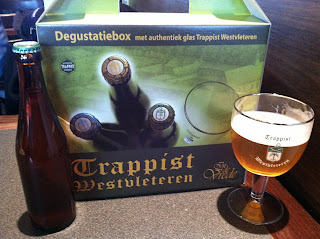


Case with four 6's, and one each 8, 12, and Westvleteren chalice
It paired wonderfully with the pate and cheese, the pate tasting like a blend of smooth fatty smoked meat and hints of black pepper. The cheese was buttery and smooth, with a gentle nuttiness that suits all the beers that Vrede has to offer.
Westvleteren 8 is the finest strong ale I have ever tried, belgian or otherwise. It was aromatically superior to the St. Bernardus Prior 8 that we had all drank hours before.
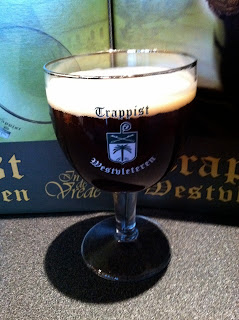
Westvleteren 12 is capped with a large meringue-like tan head that stuck around to the bottom of the glass. Magnificent lacing on the glass. Visually it is majestic.

We loaded up on beer, chocolate, and other Westvleteren swag and tried to figure out how we would handle it all while on our bike ride back. We all had around 30-40 lbs. of beer and goodies strapped into our packs as we started the ride home.

This was where I realized that the majority of the trip back would be uphill. We struggled though high winds, aching shoulders, and a uncooperative bike chain to get back to the bike store just short of 6pm. We stopped back into the Poussecafe for a little dinner and our final beer of the day.


After that, all that was left was trying to catch up on a few z's on our way back to the hotel. A wonderful end to day two. Poperinge is especially beautiful at night, by the way.


Drink good beer with good people!

Westvleteren 8
Big dark brown sugar aromas wafted up off of it's two fingers of gauzy off white head. With the mild spice of the phenols, it almost took on a warm molasses cookie aroma. No hop aroma, simply a malt showcase with a touch of alcohol, but by no means hot fusel alcohol, like in spirits. High carbonation fills the mouth and creates a soft, silky mouthfeel for the beer. It sports flavors of plum, rummy burnt sugar, and a medium-low hop bitterness and flavor (spicy, herbal) that really drives home its splendid balance.Westvleteren 12 is capped with a large meringue-like tan head that stuck around to the bottom of the glass. Magnificent lacing on the glass. Visually it is majestic.

Westvleteren 12
The malt profile starts with a breadiness that is taken over by dark fruit (fig) and burnt sugar (this is a good thing, think dark caramel). I assume that we were drinking fresh examples of these beers being that we were drinking them from the source, that being said, the alcohol was pronounced in both aroma and flavor. It is still not boozy hot, but we were probably not drinking this beer at it's peak. Remember this is a 11+% abv beer. I found the alcohol almost port-like, as it fills the sinuses with alcohol that can be perceived with exhaling. The alcohol bitterness contributes to the hop bitterness. I cannot wait to try this beer after some proper cellaring.We loaded up on beer, chocolate, and other Westvleteren swag and tried to figure out how we would handle it all while on our bike ride back. We all had around 30-40 lbs. of beer and goodies strapped into our packs as we started the ride home.

This was where I realized that the majority of the trip back would be uphill. We struggled though high winds, aching shoulders, and a uncooperative bike chain to get back to the bike store just short of 6pm. We stopped back into the Poussecafe for a little dinner and our final beer of the day.


After that, all that was left was trying to catch up on a few z's on our way back to the hotel. A wonderful end to day two. Poperinge is especially beautiful at night, by the way.


Drink good beer with good people!
Follow The Entire Experience:
Saturday, January 21, 2012
The Great Belgian Beer Run: Day One
When TGBBR was conceived, it found it's roots in spontaneity. The process was simple: passport, tickets, and hotel.

Swanky room

The Golden Tulip Hotel
Our goal for day one was Brewery Cantillon, then in the evening, the Delirium Cafe. As part of our search for appropriate coinage, we began to walk some of the side streets. They proved to be lined with innumerable small seafood restaurants boasting fresh seafood, mussels especially, and their native land's trademark beers. As we were walking along I spotted a sign that I recognized. It was the baby blue background featuring their large pink elephant on it. The Delirium Cafe.
I was relieved to find it. I was beginning to feel as if I had really slowed our trips progress by my poor planning. As we entered the lower level of the Cafe, those concerns vanished. The place is covered from top to bottom with beer collectibles of all types: signs, bottles, glassware, etc.


It was warm and welcoming inside and good refuge from the rain that we have learned is near constant in Brussels. We found ourselves a table and attempted to take on the menu. The beer menu was no problem as I was familiar with the large majority of them or the styles of beer. The food was another matter.


It was warm and welcoming inside and good refuge from the rain that we have learned is near constant in Brussels. We found ourselves a table and attempted to take on the menu. The beer menu was no problem as I was familiar with the large majority of them or the styles of beer. The food was another matter.
We approached the bar to order and spoke to the young man that was tending. He was very helpful in helping us pair our cheese and bread plate with our beer selection. The cheese whose varietal now escapes me, was a wonderful semi hard cheese that had a pleasant creamy character that melded well with the nuttiness of the bread. But those two items really sprung to life with our beer pairing. We had originally planned on trying the Delirium Tremins on tap. We had tasted this beer back home a week before and we had wanted to examine the impact of transport and poor storage on the beers we get in the States. When we asked the bartender for the beer, he suggested a different one, admitting it strange that he suggested a beer other than the beer of the brewery that employs him. He seemed to view Tremins as more of a mainstream beer and he offered us what he seemed to more of an artisanal choice, La Rulles Tripel. Pairings like this help to prove how beer is food.


Quite easily the finest Tripel I have had.

St. Feuillien as suggested by the bartender, dude knows his beer.
We systematical destroyed the cheese and bread platter as it was the first real meal we had had in a while. My Italian heritage I am sure bled through with my various sublingual utterances of excitement with our food pairing. As we drained the last of the La Rulles Tripel, which was a huge hit for all of us, we moved on the the St. Feuillien Saison. With this, our second fresh Belgian offering, a theme was developing. These beers are far more crisp and balanced when enjoyed young and properly handled. They are far hoppier, more hop flavor, and a firmer bitterness than the bottled product we get post transport. As much as we were enjoying our surroundings, we decided to continue the search for currency exchange so we could move on to Cantillon.
After some more fumbling, we found a Western Union, and located a cab. I approached the driver and held up the address of the brewery and asked if he could take us there. He said, "You aren't going to drink the beer are you?" That made me smile. He agreed to take us so we piled in, and off we went on what would turn out to be one of those beer experiences that I will always view as one of my finest.
To be continued...
Drink good beer with good people!
For the latest and a bunch of pictures from my trip follow me on Twitter: @adammmills
Follow The Entire Experience:
Saturday, July 23, 2011
Selling Craft Beer
Here is a great video from Stone Brewing CEO Greg Koch. He makes a compelling case for the profitability of craft beer when compared to BudMillerCoors products. Check it out!
Until next time, drink good beer with good people!
Salute!
Subscribe to:
Posts (Atom)